Standing on giants
Damascus, around 1350. Five times a day a man named Ibn al-Shatir must know the time — not roughly, but exactly — because he is the muwaqqit, the timekeeper, of the Great Umayyad Mosque, and the call to prayer waits on his arithmetic. He reads the time from the Sun and the stars with instruments he designs himself. And in the hours left over he does something no astronomer had managed in twelve centuries: he builds a model of the Moon that does not lie about how far away it is.
Less than two hundred years later, in a cathedral town on the Baltic coast, Nicolaus Copernicus writes down a model of the Moon. It is the same model — the same circles, turning the same way — apart from trivial differences in the numbers. Nobody has found the road by which it travelled from Damascus to Frombork. That it travelled at all is one of the great detective stories in the history of science.
This course begins in 1666, with a young man in a garden in Lincolnshire asking why an apple falls. But Isaac Newton did not begin there. When he wrote, ten years later, “If I have seen further, it is by standing on the shoulders of giants,” he was being more literal than he knew. The giants include Greeks and Englishmen. But for six hundred years the tallest of them wrote in Arabic and Persian, and worked in Baghdad, Raqqa, Cairo, Córdoba, Isfahan, Maragha, Damascus and Samarkand.
Everything you will do in this course rests on four things those giants built. A record of the sky long enough to find its patterns. A geometry able to imitate them. A trigonometry able to compute them. And instruments precise enough to prove the geometry wrong. Newton needed all four. This prologue is the story of how the world assembled them.
The atlas
Thirty-two moments, twenty-nine cities, three and a half thousand years.
Before the story, the map. Press play and watch where astronomy was done and how it moved. The arcs are translations and journeys: Babylonian records reaching Greek astronomers; Sanskrit and Persian tables carried to Baghdad; Greek books rendered into Arabic; Arabic books rendered into Latin in Toledo. The coloured bands below are the empires that paid for the work. Notice how long the gold dots stay clustered between the Tigris and the Oxus.
Clay and patience: Babylon
Mesopotamia, c. 1800–50 BCE
Orbital mechanics begins with a habit: writing down where things are, night after night, for longer than one lifetime. The scribes of Babylon, in what is now Iraq, had that habit before anyone else. One clay tablet records the appearances and disappearances of Venus across twenty-one years of a king’s reign in the seventeenth century BCE. From the seventh century BCE, astronomers kept running diaries of the Moon, the planets and the weather, and kept them for some six hundred years.
Data that long reveals cycles. The Babylonians found that eclipses repeat after 223 lunar months — about 18 years and 11 days — the cycle we still call the saros. They could predict the planets without any picture of the heavens at all, with columns of numbers that rose and fell in zigzags. And in 2016 the historian Mathieu Ossendrijver showed that they did something even more surprising with Jupiter.
Four tablets written between about 350 and 50 BCE describe Jupiter’s daily motion along the ecliptic falling steadily over 60 days, from 0;12 degrees a day to 0;9,30 (the Babylonians counted in sixties: 0;9,30 means 9/60 + 30/3600). To find how far the planet had moved, the scribe drew the motion against time — and took the area of the trapezoid underneath. The answer is 10;45 degrees. One tablet even splits the trapezoid into two equal halves to find the day on which Jupiter had covered half the distance.
Oxford scholars are usually credited with this idea — that distance is the area under a graph of speed against time — in the fourteenth century CE. The Babylonians had it some fourteen centuries earlier, in a city whose ruins stand eighty kilometres south of Baghdad. Remember the name of that later city. Most of this story happens there.
Circles upon circles: the Greeks
Alexandria and Rhodes, c. 300 BCE–150 CE
The Greeks inherited Babylonian records and added what the Babylonians never wanted: a picture. Aristarchus of Samos put the Sun at the centre around 270 BCE and was ignored. Eratosthenes measured the Earth by comparing the noon Sun at two cities. Hipparchus of Rhodes, around 130 BCE, compared his star positions with records 150 years older, found the whole sky had shifted, and discovered the precession of the equinoxes — the slow wobble of the Earth’s axis that Unit 4 of this course will make you account for in every reference frame. To do his geometry he built the first trigonometric table: a table of chords.
Then, around 150 CE in Alexandria, Claudius Ptolemy wrote the book that ruled astronomy for fourteen centuries. He called it the Mathematical Composition. We call it the Almagest — from the Arabic al-majisṭī, “the greatest” — because that is the name it carried when Europe finally received it, translated not from Greek but from Arabic. Ptolemy’s planets ride small circles (epicycles) whose centres ride large ones (deferents). It works astonishingly well. It even makes a planet stop and run backwards, as Mars really appears to do.
But to make it work, Ptolemy cheated. The epicycle’s centre does not move uniformly around the centre of its circle. It moves uniformly around a different point, the equant, set off to one side. Philosophers had taught that heavenly motion must be uniform and circular. The equant is uniform — but about the wrong point. Hold on to that discomfort. For a thousand years, the best astronomers in the world could not let it go.
One more Greek matters to you directly. Apollonius of Perga, around 200 BCE, wrote eight books on the curves you get by slicing a cone: the ellipse, the parabola and the hyperbola. They are exactly the orbits of Unit 2. Books V to VII of his Conics are lost in Greek. They survive only because ninth-century scholars in Baghdad translated them into Arabic.
The sine and the shah: India and Persia
Pataliputra, Ujjain and Ctesiphon, 499–770 CE
In 499 CE, a 23-year-old astronomer named Aryabhata finished a short book of verses in Kusumapura, near Pataliputra on the Ganges. In it the Earth turns on its axis, and the old Greek chord is cut in half. Aryabhata tabulated the half-chord, which he called jyā-ardha — later shortened to jyā, “bowstring”. A century later Brahmagupta wrote a vast astronomical treatise, the Brāhmasphuṭasiddhānta (628), that also gave rules for computing with zero.
Between India and the Mediterranean lay Persia. Its Sasanian kings (224–651) kept royal astronomical tables, the Zīj-i Shāh, and their capital, Ctesiphon, sat on the Tigris thirty kilometres from where Baghdad would be built. When the Sasanian empire fell to the armies of Islam in the 650s, its astronomers, their tables and their language did not disappear. They became one of the three roots — Greek, Indian, Persian — from which Islamic astronomy grew.
One language from Spain to the Indus: the Umayyads
Damascus 661–750, and Córdoba 756–1031
The Umayyad caliphs ruled from Damascus, and within a century of the Prophet their empire stretched from the Atlantic coast of Spain to the Indus. Their great gift to astronomy was not an observatory. It was a language. Around 700 CE the caliph ʿAbd al-Malik made Arabic the language of government across the whole empire — its registers, its coins, its chancery. A clerk in Córdoba and a clerk in Samarkand now wrote the same script. That is why, a century later, a book translated in Baghdad could be read, copied and argued with from Spain to Central Asia. Science needs a common language before it can have a common conversation. The Umayyads gave it one.
They also built the Great Mosque of Damascus (705–715) — the mosque where, six centuries later, Ibn al-Shatir would keep time and redesign the Moon, and where a copy of his great sundial of 1371 still stands on the minaret today.
When the Abbasids overthrew the Umayyads in 750, one Umayyad prince escaped to Spain and founded a new state at Córdoba. Under the Umayyads of al-Andalus — caliphs themselves from 929 — Córdoba became one of the largest and most learned cities in Europe. There, around 1000, Maslama al-Majriti recast al-Khwarizmi’s astronomical tables for the meridian of Córdoba. In Toledo, a generation after the caliphate fell, al-Zarqali (Arzachel to Europe) built an astrolabe that worked at every latitude, helped compile the Toledan Tables, and showed that the Sun’s apogee creeps slowly forward among the stars.
Spain is the door through which all of this reached Latin Europe. Adelard of Bath translated al-Khwarizmi’s tables, in Maslama’s version, into Latin in 1126. In Toledo, Gerard of Cremona translated the Almagest from Arabic in 1175. For the next four centuries, European astronomers learned their craft from books whose authors had Arabic names.
Maslama al-Majriti
مسلمة المجريطيal-Zarqali (Arzachel)
الزرقاليThe House of Wisdom: the Abbasid centuries
Baghdad and the Islamic East, 750–1258
On 30 July 762, at an hour chosen by his astronomers — the Persian Nawbakht and the Jewish astronomer Māshāʾallāh — the Abbasid caliph al-Mansur laid the first brick of a new capital on the Tigris. It was round, it was called the City of Peace, and the world knows it as Baghdad. Within a decade an embassy from India brought a Sanskrit astronomical text to al-Mansur’s court, and al-Fazari helped turn it into Arabic as the Zīj al-Sindhind — carrying with it the Indian numerals that Europe would later call “Arabic”.
Al-Mansur’s great-grandson, the caliph al-Maʾmūn (reigned 813–833), turned curiosity into policy. In the House of Wisdom (بيت الحكمة), scholars paid by the state translated Greek, Persian and Sanskrit science into Arabic — Ptolemy, Euclid, Apollonius, Aristotle — and then did what translators rarely do: they checked it. Al-Maʾmūn built observatories at al-Shammāsiyya in Baghdad (828) and on Mount Qāsiyūn above Damascus to test Ptolemy’s numbers against the sky. They found them wanting.
He also ordered the Earth measured. On the flat plain of Sinjar, north-west of Baghdad, two survey parties set out from one spot — one due north, one due south — measuring the ground with rods and ropes, until the altitude of the celestial pole had changed by exactly one degree.
Muḥammad ibn Mūsā al-Khwārizmī
محمد بن موسى الخوارزميal-Farghānī (Alfraganus)
الفرغانيThābit ibn Qurra
ثابت بن قرةal-Battānī (Albategnius)
محمد بن جابر البتانيThe Persian century
As the caliphs’ political power faded in the tenth century, Persian dynasties — the Buyids in western Iran and Iraq, the Samanids and Ghaznavids in the east — took over the patronage of science. What followed was perhaps the most brilliant century in the history of astronomy before Kepler, and almost all of its stars were Persian.
ʿAbd al-Raḥmān al-Ṣūfī (Azophi)
عبد الرحمن الصوفي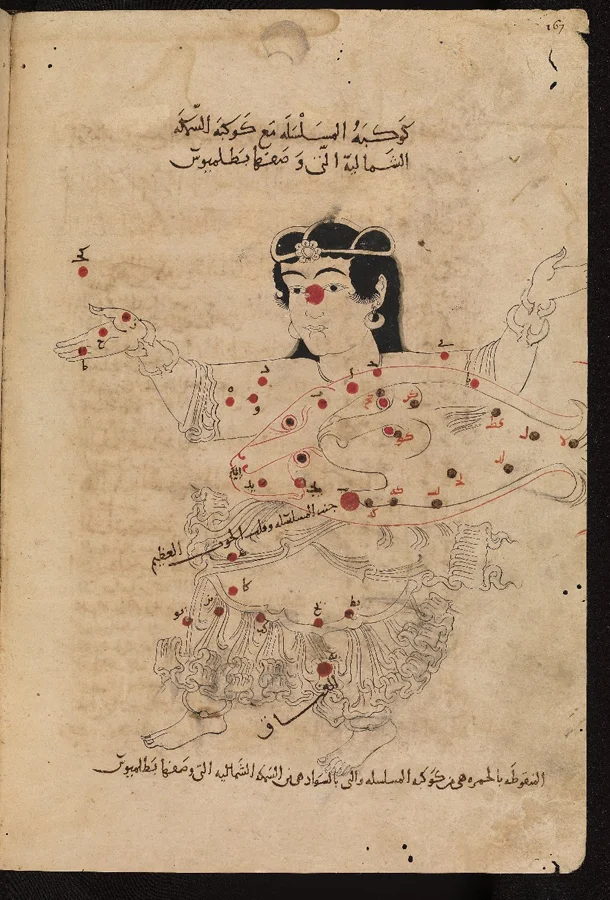
Abū al-Wafāʾ al-Būzjānī
أبو الوفاء البوزجانيIbn Yūnus
ابن يونسIbn al-Haytham (Alhazen)
الحسن بن الهيثمThe duty of the man who investigates the writings of scientists, if learning the truth is his goal, is to make himself an enemy of all that he reads, and … attack it from every side.
Abū Rayḥān al-Bīrūnī
أبو ريحان البيروني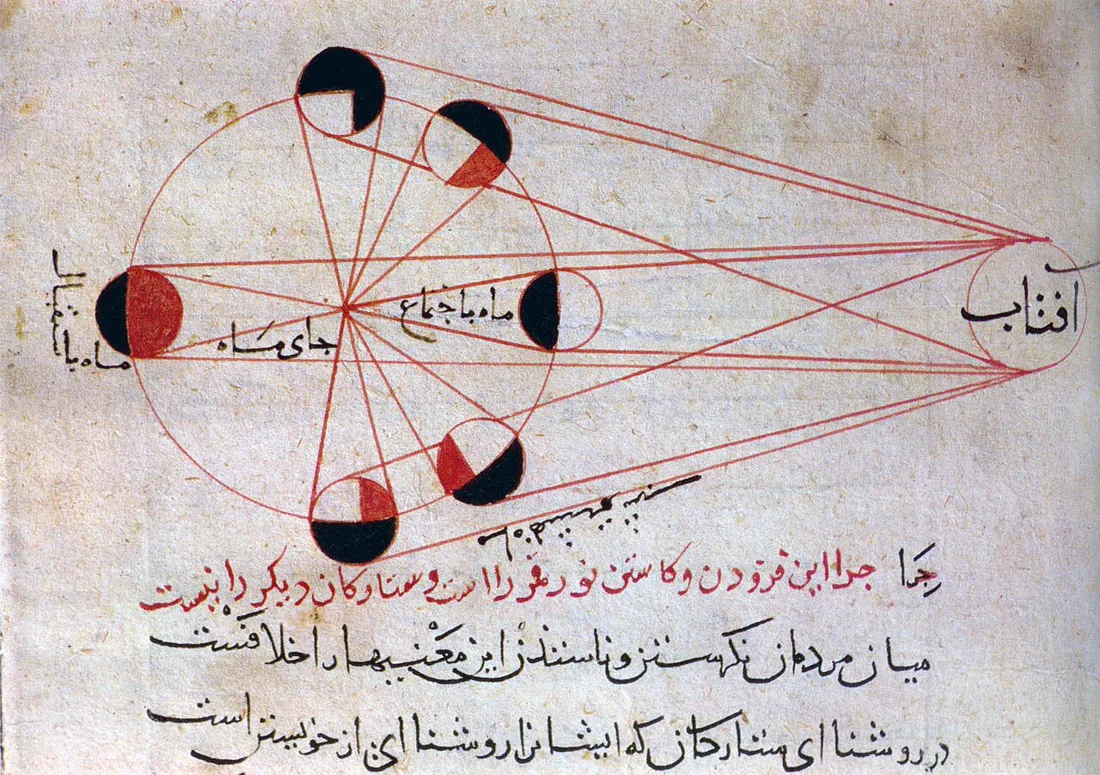
Breaking the equant: Maragha and Damascus
1259–1375
In February 1258 the Mongol army of Hülegü took Baghdad. The last Abbasid caliph was killed, the city was sacked, and the House of Wisdom ceased to exist. It is the darkest date in this prologue. What happened next is one of its most surprising.
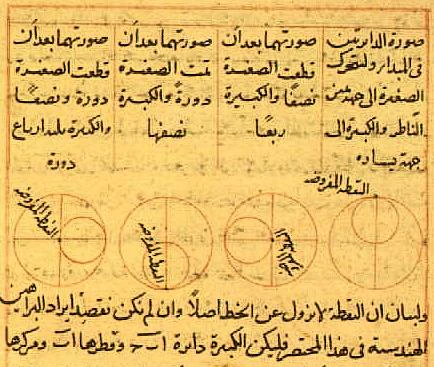
The following year, the Persian polymath Naṣīr al-Dīn al-Ṭūsī persuaded Hülegü to fund an observatory at Maragha, in north-western Iran. It became the first great research institute of astronomy: a hilltop of instruments, a library, salaried astronomers from Damascus to China, and twelve years of observations behind the Zīj-i Īlkhānī (1272). And it became the headquarters of a revolution — the attempt to rebuild Ptolemy’s astronomy so that every motion in it was uniform and circular, without the equant.
Al-Tusi’s key tool was a device so simple it looks like a toy. Roll a circle inside another circle twice its size. Every point on the small circle moves back and forth along a straight line. Two uniform circular motions, added together, give straight-line motion — exactly what is needed to reproduce the equant’s effect without the equant. Historians now call it the Tusi couple.
Naṣīr al-Dīn al-Ṭūsī
نصیرالدین طوسیThe timekeeper of the Umayyad Mosque
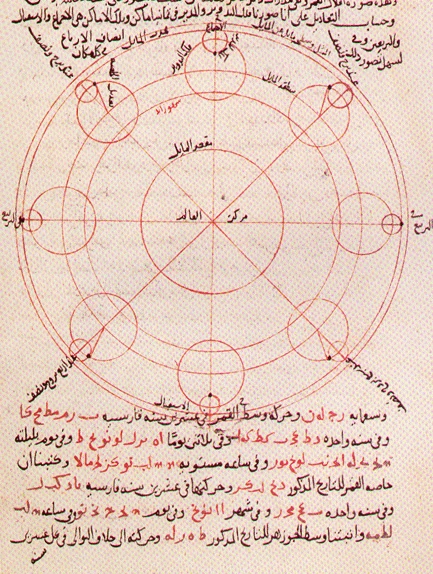
The Maragha programme reached its peak not in Iran but in Damascus, with the man this prologue began with. Ibn al-Shatir looked hard at Ptolemy’s Moon and found a flaw nobody could miss once it was pointed out. To get the Moon’s positions right, Ptolemy’s “crank” pulls the Moon nearly twice as close to the Earth at some quarter Moons as at some full Moons. If that were true, the Moon’s disc would look almost twice as wide. Anyone can see that it does not.
Ibn al-Shatir threw out the crank and the equant together. His Moon rides a circle centred on the Earth, carrying an epicycle, carrying a second, smaller epicycle. The positions come out as well as Ptolemy’s. The distance hardly swings at all.
Ibn al-Shāṭir
ابن الشاطرThe prince’s observatory: Samarkand and Istanbul
1420–1580
The last great observatory of the medieval world was built by a king who preferred mathematics to war. Ulugh Beg, grandson of Timur, governed Samarkand and filled it with scholars. In the 1420s he built an observatory on a hill outside the city. Its centrepiece was a giant arc cut into the rock along the meridian, with a radius of about 40 metres (sources give between 36 and 40). The trench survives; you can still walk down into it.
At noon a beam of sunlight through an opening above fell on the graduated arc, and the spot it made gave the Sun’s altitude. The bigger the arc, the finer the graduation. From such measurements Ulugh Beg’s team produced the Zīj-i Sulṭānī (1437), with a new catalogue of about a thousand stars and a sidereal year of 365 days, 6 hours, 10 minutes and 8 seconds, about a minute too long.
Ulugh Beg
الغ بیگJamshīd al-Kāshī
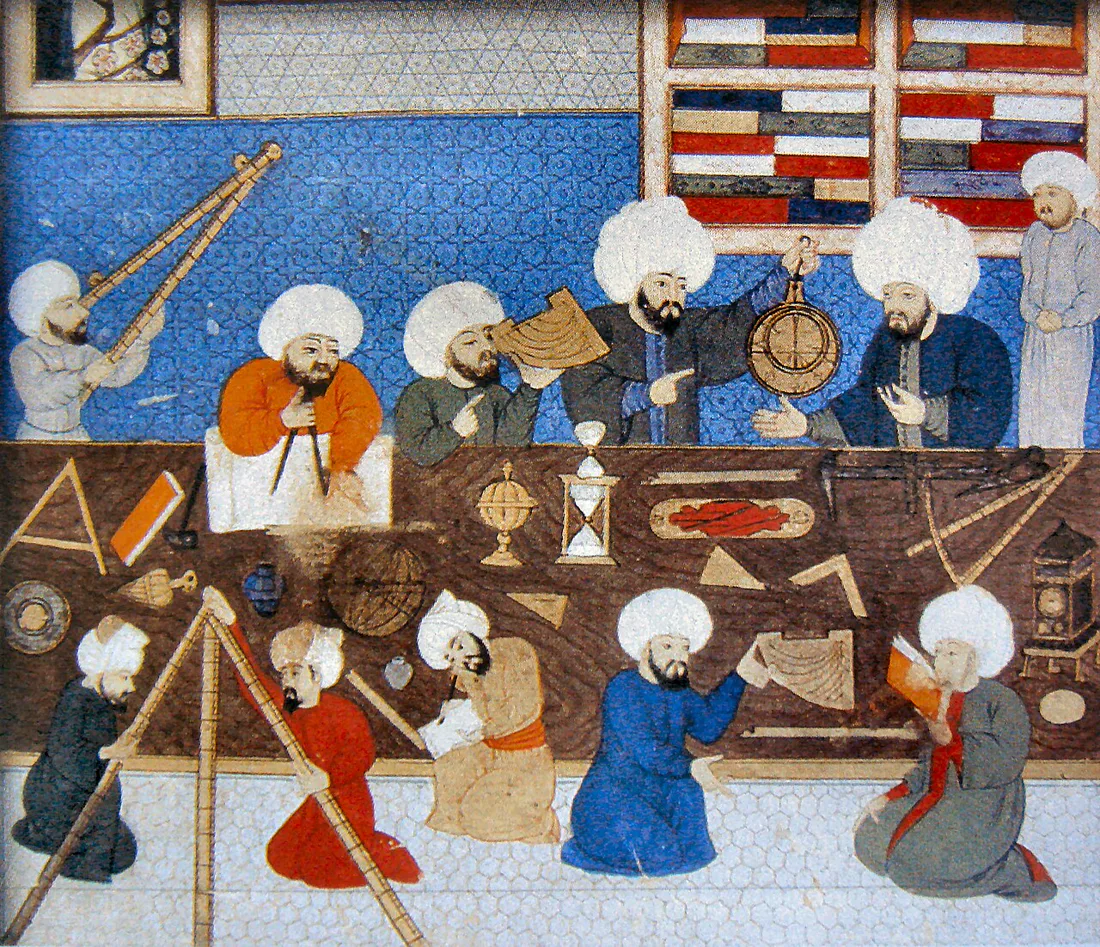
غیاثالدین جمشید کاشانیAfter Ulugh Beg’s death his astronomer ʿAlī Qūshjī carried Samarkand’s science to the Ottoman court in Istanbul, where he argued that astronomy did not need Aristotle’s physics and that nothing observed in the heavens proved the Earth stood still. A century later, in 1577, Taqī al-Dīn opened an observatory in Istanbul with instruments as fine as any in the world — the same years in which Tycho Brahe was building Uraniborg in Denmark. In January 1580 it was demolished by order of the sultan.
Meanwhile, elsewhere
The sky was watched everywhere
This prologue follows one river, but there were others. In China, Guo Shoujing built giant instruments and in 1280 produced the Shoushi calendar with a year of 365.2425 days — exactly the value the Gregorian reform adopted three centuries later. The Maya kept a Venus table in what is now the Dresden Codex, tracking the planet’s 584-day cycle for generations. In Kerala, in southern India, Madhava found infinite series for the sine and cosine in the fourteenth century, and in 1501 Nilakantha Somayaji proposed a model in which Mercury and Venus circle the Sun.
And in Latin Europe, the universities that grew up in the twelfth and thirteenth centuries read their astronomy from the Arabic. When Peurbach and Regiomontanus wrote their Epitome of the Almagest (printed 1496), a book Copernicus studied closely, he was working in a tradition whose recent masters had been al- Battani, al-Zarqali and al-Farghani.
The hand-over: Copernicus to Kepler
1514–1619
Around 1514, Copernicus circulated a short manuscript, the Commentariolus; in 1543, as he lay dying, De revolutionibus was printed. He moved the Sun to the centre. But look at his machinery and you find the Maragha school’s: no equant, the Tusi couple, Ibn al-Shatir’s Moon. His revolution was in where he put the centre. His geometry was inherited.
Tycho Brahe then measured the planets, with the naked eye, more accurately than anyone ever had — the European heir to Maragha and Samarkand. And Johannes Kepler, working in Prague with Tycho’s observations of Mars, finally dropped the circles. In 1609 he announced that the planets move on ellipses, with the Sun at a focus, sweeping equal areas in equal times; in 1619, that the square of a planet’s period goes as the cube of its distance. To find a planet’s place on its ellipse at a given time he had to solve an equation with no algebraic solution — Kepler’s equation, which you will solve in Unit 5 by iteration, as al-Kashi would have.
Apollonius had given Kepler the ellipse. The Babylonians had given him the idea that position is accumulated motion. Hipparchus and al-Battani had given him precession and the drifting apogee; Abu al-Wafa and al-Tusi the trigonometry; Ibn al-Haytham the conviction that a model must be physically possible; Maragha and Damascus the proof that Ptolemy could be rebuilt; Ulugh Beg and Tycho the standard of measurement. Kepler’s laws are where four thousand years of looking arrived.
What they left in your course
Look closely and it is everywhere
You will meet their work in this course without their names attached. Here are the names.
- algorithm — from al-Khwārizmī, Latinised as Algoritmi
- algebra — from al-jabr, in the title of his book
- sine — jyā → jība → jayb → sinus
- zenith — from samt al-raʾs, “the direction of the head”
- azimuth — from al-sumūt, “the directions”
- nadir — from naẓīr, “opposite”
- almagest — from al-majisṭī, “the greatest”
- Aldebaran — al-Dabarān, “the follower”
- Altair — al-Nasr al-Ṭāʾir, “the flying eagle”
- Vega — al-Nasr al-Wāqiʿ, “the swooping eagle”
- Deneb — dhanab, “tail”
- Rigel — rijl, “foot”
- Algol — raʾs al-ghūl, “the demon’s head”
- Betelgeuse — from yad al-jawzāʾ, “hand of al-Jawzāʾ”
| Distance as the area under velocity (Babylon) | Unit 5 · Orbit propagation |
| The ellipse, parabola and hyperbola (Apollonius, preserved in Arabic) | Unit 2 · Conic sections |
| Spherical trigonometry (Abu al-Wafa, al-Tusi) | Unit 3 · Ground tracks |
| Precession (Hipparchus, al-Battani, Maragha) | Unit 4 · Precession and nutation |
| Sidereal time and the turning sky (the astrolabe) | Unit 4 · Terrestrial frames |
| Iteration (al-Kashi) and Kepler’s equation | Unit 5 · Kepler’s equation |
| The Earth’s size (Sinjar, al-Biruni) | Unit 1 · The Moon test |
Turn the page
Here is the strange thing about four thousand years of brilliance. Every astronomer in this prologue could tell you where a planet would be. Not one of them could tell you why it went there. The Babylonians had numbers, the Greeks had circles, Maragha had better circles, Kepler had ellipses. All of them were descriptions. The heavens moved by their own rules — beautiful, mathematical, and entirely separate from the rules that make a stone fall.
In 1666, plague closed the University of Cambridge, and a twenty-three-year-old went home to his mother’s farm in Lincolnshire with Kepler’s laws in his head and nothing to do. He asked whether the force that pulls an apple down might be the force that holds the Moon up.
That question is Lesson 1-1. It is where description becomes explanation, and where astronomy becomes orbital mechanics. Everything you have just read is what he was standing on.
- M. Ossendrijver, “Ancient Babylonian astronomers calculated Jupiter’s position from the area under a time-velocity graph”, Science 351 (2016) 482–484.
- G. Saliba, Islamic Science and the Making of the European Renaissance, MIT Press, 2007.
- F. J. Ragep, Naṣīr al-Dīn al-Ṭūsī’s Memoir on Astronomy (al-Tadhkira fī ʿilm al-hayʾa), Springer, 1993.
- V. Roberts, “The Solar and Lunar Theory of Ibn ash-Shāṭir: A Pre-Copernican Copernican Model”, Isis 48 (1957) 428–432.
- N. M. Swerdlow and O. Neugebauer, Mathematical Astronomy in Copernicus’s De Revolutionibus, Springer, 1984.
- D. A. King, In Synchrony with the Heavens, Brill, 2004–2005.
- T. Hockey et al. (eds), The Biographical Encyclopedia of Astronomers, Springer — entries on each astronomer named here (Islamic astronomers, McGill).
- Where sources disagree — the route of the Tusi couple to Copernicus, the radius of Ulugh Beg’s arc, the length of the Arabic mile, the exact pattern of the Jalali leap years — this page says so rather than choosing.
Images: al-Sufi’s Andromeda © Bodleian Library, University of Oxford, MS. Marsh 144 p. 167, CC BY 4.0; al-Biruni’s lunar phases, al-Tusi’s couple, Ibn al-Shatir’s lunar model and the Istanbul observatory miniature are public-domain reproductions via Wikimedia Commons. Coastlines: Natural Earth (public domain).